· Dark Oak · 7 min read
Most Irish SMEs we talk to start the same conversation: “We’ve outgrown the SaaS but we’re not sure we need a custom build.” It’s a fair question, and it’s a consequential one. Whatever you pick, you’re usually committing to it for the next five years — both in money and in the muscle memory of your team. Get it wrong and you either pay SaaS seat fees long past the point they make sense, or you sink €40k into a custom system that does what a €120/month tool would have done with two integrations bolted on.
We’re a custom-software shop. We’d benefit if every reader of this post decided to build something. But honestly, most shouldn’t — at least not yet, and not for the whole thing. So here’s how we think about the decision when an SME owner or ops lead asks us.
The four real options (not two)
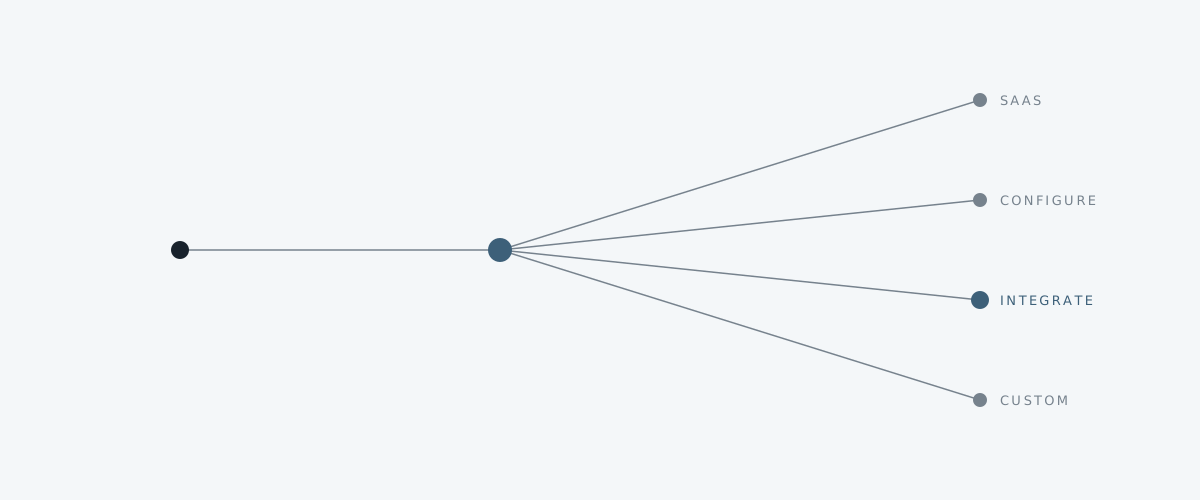
The framing we keep hearing is “SaaS vs custom”, and it’s the wrong framing. There are at least four real options, and the middle two are where most SMEs end up:
- SaaS as it ships (Xero, HubSpot, Shopify, Pipedrive, Monday, etc.). When this fits: your workflow looks broadly like everyone else’s in your sector. When this stops fitting: you’re running parallel spreadsheets to handle the bits the SaaS doesn’t, and those spreadsheets are now load-bearing.
- SaaS configured and extended via its app marketplace. When this fits: the gap between you and the default product is real but small, and someone on the marketplace has already solved it. When this stops fitting: you’re paying for four or five add-ons, none of them talk to each other, and your admin person has become a full-time integrator.
- SaaS plus a thin integration layer — Zapier, Make, n8n, or a small custom service that talks to APIs. When this fits: you have two or three SaaS tools that need to share data, and the shape of that data is stable. When this stops fitting: the integration logic is now more complex than the SaaS it’s connecting, and every change to either tool breaks something downstream.
- Full custom build. When this fits: the workflow is genuinely distinctive, it’s stable enough to justify the build, and no combination of the above gets you there. When this stops fitting: honestly, it rarely stops fitting once you’re here — but you should have arrived at this option by elimination, not by preference.
If you’re tempted to skip to option four because you want “your” system, slow down. We’ll come back to that.
Five questions that move the needle
We ask some version of these five questions in every discovery call. They’re the questions that actually change the answer.
How distinctive is the workflow?
The honest test: if you described your workflow to a competitor in your sector, would they nod along, or would they say “huh, that’s interesting”? If it’s nodding, you’re in SaaS territory. The whole reason SaaS exists is to amortise the cost of common workflows across thousands of customers. You will not out-build Xero at being Xero.
If it’s “huh, that’s interesting” — particularly if the distinctive part is the part that makes you money — then custom starts to make sense. But notice the bar: not “we do things a bit differently”, but “the way we do this is actually a competitive advantage”.
How often does the workflow change?
Custom software is brilliant when you know exactly what you need and that need will be stable for three to five years. It’s painful when the workflow shifts every six months, because every shift is a change request and a deploy.
Configurable SaaS is the opposite: it’s a bit awkward at any given moment, but you can change the configuration on a Tuesday afternoon without ringing anyone.
A rule of thumb: if you’re still figuring out how the workflow should work, don’t build custom yet. Use SaaS to learn what the workflow actually is, then build custom (if you still need to) once it’s locked in.
What does the SaaS roadmap not cover that you can’t live without?
This is where vague answers cost people the most money. “We need better reporting” is not a reason to build custom. “We need to report on margin by SKU, grouped by supplier, with a rolling 13-week view, and Shopify reports can’t do the grouping” — that’s a specific gap you can actually evaluate.
Once you’ve got the gap written down in one sentence, ask the SaaS vendor if it’s on the roadmap. Ask their support. Check the changelog from the last 12 months. If it’s coming in Q1, wait. If it’s been “on the roadmap” for two years with no movement, treat it as not coming.
What’s the integration story?
This is the one we see SMEs underestimate the most. If your real problem is “our CRM doesn’t talk to our accounting tool and our warehouse system”, the answer is almost never custom software. It’s a small integration layer — sometimes Zapier or Make, sometimes a few hundred lines of code running on a small server, sometimes a productised integration tool you can buy.
Most two-system integrations land somewhere in the €4k–€12k range to build properly, with maintenance after that. If that gets you 80% of the value of a custom build, take it. We’ve talked clients out of full custom builds on this basis more than once.
What’s the 5-year cost of ownership?
Do the maths properly. SaaS at €40 per seat per month, across 25 users, is €12,000 a year, or €60,000 over five years — and that’s before the inevitable price rises and the add-ons. A custom build at €40,000 plus a €200/month Care plan is €52,000 over five years and the cost line is flat.
That arithmetic flips at different points for different shapes of business. Lots of users with broadly standard needs → SaaS keeps winning. A small team with a very specific workflow that needs constant attention → custom often pulls ahead by year three. Run the numbers for your actual user count and your actual seat price, not the marketing-page price.
Where we see SMEs making this call wrong
Four patterns we see repeatedly:
- Buying custom too early because they want “their” system. This is usually a founder-led decision and it’s usually emotional. The system feels like part of the company identity. It’s a €40k feeling. Wait until the workflow is genuinely distinctive and stable before paying for it.
- Sticking with SaaS too long because switching feels expensive. The flip side. The SaaS isn’t fitting anymore, everyone knows it, but the cost of migrating data and retraining the team feels enormous so nothing changes. Meanwhile the team is doing manual workarounds that cost more in hours every month than a proper build would cost in a year.
- Treating integration as cheap when it’s actually the bulk of the work. “We’ll just integrate it” is the most underestimated phrase in any scoping conversation. Glue code is the work. If you’re going to do it, scope it properly, give it a budget, and treat it as a project — not a Friday afternoon job for whoever’s free.
- Ignoring the Care/maintenance cost line in a custom build. Software needs maintenance. Libraries get deprecated, APIs change, browsers update, security patches land. If you’re costing a custom build and you haven’t put a line in for ongoing care, your five-year cost is wrong. We quote Care plans from €100/month for a reason — it’s not optional, it’s the cost of the system still working in year three.
What we’d recommend most of the time
For most Irish SMEs we talk to, the honest answer is: start with SaaS, add an integration layer when you outgrow it, and only commission a custom build when the workflow is genuinely distinctive and stable enough to justify it. That order matters. Each step teaches you what you actually need from the next one.
The same logic applies to AI, by the way. Most of the “AI agent” work we do for SMEs right now is integration work — taking an off-the-shelf model, wiring it into the tools the business already uses, and putting some guardrails around it. Very little of it is bespoke model training, and it shouldn’t be. If your AI project is really an integration project, scope it as an integration project. It’ll cost less and ship faster.
The cases where we genuinely recommend custom software are narrower than people think: a distinctive operational workflow that’s central to how the business makes money, a stable enough understanding of that workflow to write requirements that won’t change every quarter, and a five-year horizon where the cost arithmetic actually clears. When all three line up, custom is the right call and we’d be glad to build it. When they don’t, we’ll usually point you at a SaaS-plus-integration approach — even when that means a smaller engagement for us.
If you’re in the middle of this call right now and you’re not sure which of the four options you’re really looking at, get in touch. We do 30-minute discovery calls and we’ll talk it through honestly — no hard sell, and if the answer is “stay on Shopify and bolt on two integrations”, we’ll tell you that.